

Driving in Austria in 2026: Traffic Rules, Fines, Vignettes, and Toll Roads
Table of contents
- Basic Traffic Rules in Austria in 2026
- Fines for Traffic Violations in Austria in 2026
- Vignette in Austria in 2026: How Much It Costs and Where It’s Required
- Toll Tunnels and Section Tolls in Austria
- What happens if you drive through Austria without a vignette?
- Parking in Austria: Kurzparkzone and Rules in Vienna
- What documents are required to travel through Austria by car?
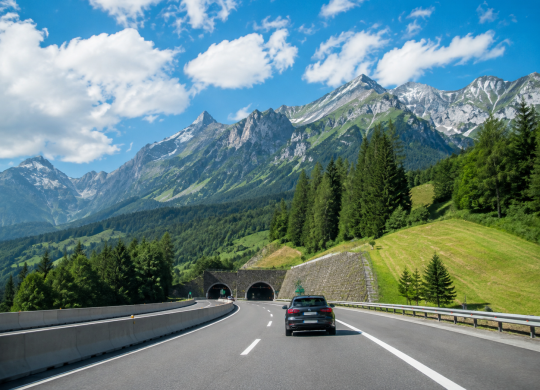
To travel through Austria by car, it’s not enough to simply purchase a vignette: additional tolls apply on certain Alpine routes, and violations of the rules can result in significant fines. Drivers should also be aware of speed limits, the Rettungsgasse emergency lane, winter equipment requirements, and the specifics of the digital vignette. Learn more about traffic laws, fines, toll roads, and the rules for driving in Austria in 2026

Traveling through Austria by car involves several important details: a vignette is required on most highways, and certain tunnels and Alpine sections incur additional tolls. In addition, drivers should be aware of local speed limits, the Rettungsgasse rules, winter driving requirements, and fines for violations.
In this article, we’ll cover Austria’s traffic laws in 2026, the cost and types of vignettes, toll roads, fines, required documents, and other important rules for driving in the country.
Are you planning a trip to Europe by car?
In many countries, highways are tolled and require an electronic road vignette. This is a digital permit that confirms payment for the use of toll roads and is checked automatically by the license plate number - without stickers and paper receipts. Making a vignette online before you travel will help you avoid fines, travel delays, and unpleasant situations during inspections.

Basic Traffic Rules in Austria in 2026
In Austria, traffic drives on the right, and the basic rules generally align with the standards of most EU countries. However, there are a few nuances that are particularly important for tourists: strict speed enforcement, the mandatory emergency lane in traffic jams, and seasonal tire requirements.
The following standard speed limits apply to passenger cars:
- 50 km/h — in built-up areas
- 100 km/h — outside built-up areas
- 130 km/h — on highways and expressways
Lower limits may apply on certain sections, particularly due to roadwork, safety, or environmental requirements. Therefore, you should first and foremost follow the posted road signs.
Seat belts are mandatory for the driver and passengers. Children must be transported using an appropriate restraint system based on their age and height. It is also prohibited to hold a cell phone in your hand while driving.
One of Austria’s distinctive requirements is the Rettungsgasse, or emergency corridor. As soon as a traffic jam forms on a highway or expressway, drivers must clear a passage for emergency services between the far-left lane and the adjacent lane to the right. The corridor must be formed even before an ambulance or fire truck arrives. Blocking the Rettungsgasse or driving through it illegally can result in a fine of up to €2,180.
Special rules apply during the winter months. From November 1 through April 15, passenger cars and vehicles weighing up to 3.5 metric tons must use winter tires if winter conditions—such as snow, slush, or ice—are present on the road. As an alternative, under certain conditions, snow chains are permitted on at least two drive wheels.
To learn more about which European countries have introduced new speed limits on highways, follow the link.
Fines for Traffic Violations in Austria in 2026
In Austria, there is no single, concise “price list” for all traffic violations: the amount depends on the severity of the situation, how the violation was documented, and the decision of the competent authority. For serious violations, a driver may face not only a fine but also a temporary driving suspension. Speed, alcohol, cell phone use, and failure to form an emergency corridor are subject to particularly strict enforcement.
Among the violations tourists should pay the most attention to:
1. Speeding can result not only in a fine but also in a suspension of your driver’s license; penalties are significantly harsher for substantial speeding violations
2. Using a cell phone without a hands-free device while driving is prohibited and considered a serious violation, particularly for drivers with a probationary license
3. Running a red light, dangerous passing, or failing to yield the right of way are also classified as serious traffic violations
4. Blocking a Rettungsgasse (emergency lane) or driving through it illegally can result in a fine of up to €2,180
5. Specific penalties apply for violations of the rules regarding the use of seat belts and child restraint systems
For most drivers, the permissible blood alcohol level is less than 0.5‰. For drivers with a probationary license, a much stricter limit applies—up to 0.1‰. Violating this rule can result not only in a fine but also in additional training and an extension of the probationary period.
In Austria, it’s also important to be aware of automatic speed enforcement. Cameras can be stationary or mobile, and in certain areas, “Section Control” is used, which measures a vehicle’s average speed over a specific stretch of road.
Foreign vehicle registration does not exempt you from liability. If a violation is recorded by a camera, the vehicle owner can be identified through international data exchange; in the case of a rental car, the rental company may additionally charge an administrative fee for providing the driver’s information.
We previously discussed the most common reasons tourists are fined on European roads in 2026.
Vignette in Austria in 2026: How Much It Costs and Where It’s Required
For passenger cars weighing up to 3.5 metric tons, a valid vignette is required on most Austrian highways and expressways. It can be digital or in the form of a sticker on the windshield. The exception is the 1-day vignette, which is available only in digital format.
In 2026, the following rates apply for passenger cars:
- 1 day — €9.60
- 10 days — €12.80
- 2 months — €32.00
- 1 year — €106.80
For a short tourist trip, a 1-day or 10-day vignette is usually sufficient. It is important to correctly enter the license plate number, country of registration, and the start date of the digital vignette, as it is tied specifically to the vehicle.
In our previous article, we discussed where in Europe it’s cheapest and fastest to charge an electric vehicle.
The Important 18-Day Rule
If a private individual purchases a 2-month or annual digital vignette online directly from ASFINAG, it usually becomes valid only on the 18th day after purchase. This is due to the consumer’s legal right to cancel an online purchase.
This restriction does not apply to 1-day and 10-day digital vignettes—they can be activated immediately. It also does not apply to business customers.
Therefore, it is not advisable to purchase an annual or 2-month digital vignette at the last minute before departure through the ASFINAG online store. If your trip is approaching, you should check the available purchase options that take effect immediately.
Is a vignette required on all toll roads?
No. In Austria, there are separate section toll routes—stretches with special tolls, primarily in the Alps. On these routes, a separate toll is paid instead of the standard vignette. Such routes include the A13 Brenner, A10 Tauern/Katschberg, A11 Karawanken, A9 Bosruck and Gleinalm, and S16 Arlberg.
For example, the entire A13 Brenner Autobahn is a separate toll section and can be used without a vignette. However, if a driver approaches it via the A12 Inntal Autobahn, a vignette is required for that road.
That is why, before traveling through Austria, it is important to check not only whether you have a vignette but also whether the route passes through any sections with additional tolls.
Learn more about current toll rates in Poland for 2026 by following the link.
Toll Tunnels and Section Tolls in Austria
In addition to the vignette, Austria has a section toll (Streckenmaut)—a separate fee for traveling on the most challenging and expensive-to-maintain Alpine sections. In 2026, ASFINAG will collect this toll on six routes. On the sections between the section toll collection points themselves, a standard vignette is not required, but it may be needed on the highways leading to and from that section.
For passenger cars in 2026, the main rates are as follows:
- A9 Pyhrn – Bosruck Tunnel — €7 per trip
- A9 Pyhrn – Gleinalm Tunnel — €12
- A10 Tauern/Katschberg — €15 for the entire toll section
- A11 Karawanken — €9
- A13 Brenner — €12.50 for the entire route
- S16 Arlberg Tunnel — €13
On the A10, you can also pay for individual sections of the route: travel through the Tauern Tunnel or Katschberg Tunnel costs €7.50 each, while the full section between Flachau and Rennweg costs €15. On the A13 Brenner, separate rates are also set for shorter sections, and the full trip costs €12.50.
You can pay the section toll directly at the toll plaza in cash or by credit card, or you can purchase the Digital Section Toll in advance. In this case, the ticket is linked to your license plate; your vehicle is automatically recognized at the toll plaza, and you can use the designated lane without stopping.
For those planning multiple such routes, ASFINAG also offers the Digital Section Toll FLEX: after registering the license plate, tolls for toll sections are automatically deducted after each trip. However, FLEX does not replace the vignette on those highways where it is mandatory.
Before traveling through the Alps, it is especially important to check the entire route. For example, you can drive on the A13 Brenner without a vignette by paying only the section toll, but on the A12 Inntal—which many drivers use to reach the Brenner—a vignette is required.

Learn more about the world’s best countries for road trips in 2026 by following the link.
What happens if you drive through Austria without a vignette?
Vignette enforcement in Austria is automated: license plates are checked by ASFINAG’s stationary and mobile systems, as well as by highway inspectors. Therefore, the absence of a sticker on the windshield does not mean that the digital vignette will not be checked—its validity is determined by the vehicle’s license plate number.
If a vehicle uses a highway or expressway without a valid vignette, the driver may be asked to pay the Ersatzmaut—a substitute toll. If this fee is not paid by the deadline, the case proceeds to administrative proceedings, where the fine can reach €3,000.
It is important to remember that paying the Ersatzmaut does not replace the vignette for future trips. After paying this fee, the vehicle still requires a valid vignette if the route continues on the toll network of Austrian autobahns.
Problems may also arise if a digital vignette has been purchased but the driver incorrectly entered the license plate number, country of registration, or start date. Before entering the highway, it is best to verify the digital vignette through the official ASFINAG database—the service shows whether a valid vignette or Digital Section Toll is active for a specific license plate number.
You’ll also need to check the section toll separately. A standard vignette does not cover the special toll on those Alpine sections where it applies. If such a section is not paid for properly, an Ersatzmaut may also be charged, and late payment results in an administrative fine.
In a previous article, we reported that Europe is introducing mandatory surveillance cameras to monitor drivers.
Parking in Austria: Kurzparkzone and Rules in Vienna
In Austria, tourists should pay attention to Kurzparkzone—short-term parking zones. These may cover individual streets or entire districts, and the rules, rates, and maximum parking times are set at the local level. The zone is marked by road signs; blue road markings may also be used but are not mandatory.
A particularly strict system is in place in Vienna, where all city districts are designated as short-term parking zones. On weekdays from Monday through Friday, these zones are generally in effect from 9:00 a.m. to 10:00 p.m., and without a Parkpickerl resident permit, you may park for a maximum of 2 hours.
As of January 1, 2026, the following rates apply in Vienna:
- 15 minutes — free
- 30 minutes — €1.70
- 60 minutes — €3.40
- 90 minutes — €5.10
- 120 minutes — €6.80
Parking requires a Parkschein—a parking ticket that can be obtained through the city’s designated system. Even for the free 15-minute parking, you must properly validate the corresponding parking ticket.
An important detail: if a Kurzparkzone covers an entire district, there may not be repeated signs on every street within it. Therefore, it’s easy for a tourist to overlook the fact that their car is already in a paid parking zone. This is particularly relevant in Vienna, as short-term parking applies to all districts.
In other Austrian cities, the rules may differ in terms of validity periods, rates, and maximum parking durations. Therefore, before leaving your car in Salzburg, Innsbruck, Graz, or any other city, it’s best to check the local signs and the official regulations of the specific municipality.
We previously reported that Europe is introducing new measures to combat drunk driving: cars won’t start after alcohol consumption.
What documents are required to travel through Austria by car?
Before traveling through Austria, drivers must have documents for themselves and their vehicle. Simplified rules apply to travelers from EU and EEA countries, but requirements may differ for licenses issued outside the EU.
While on the road, you should have:
- A valid driver’s license
- Vehicle registration certificate
- Passport or other document proving your identity and granting entry rights
- Proof of liability insurance
- Documents from the rental company, if the vehicle is rented
Driver’s licenses issued by EU and EEA countries are recognized in Austria. For licenses from non-EU countries, an international driver’s license or a German translation may be required, depending on the country of issue. Therefore, it’s best to check this before your trip.
If the vehicle is registered abroad, be sure to check whether the insurance coverage is valid in Austria and other countries along your route. For vehicles registered in the EU, mandatory third-party liability insurance is valid throughout other EU member states.
Green Card for Road Trips in Europe
If your vehicle requires a Green Card insurance certificate for an international trip, you should obtain it before crossing the border and verify that it is valid for the entire route.
Through Visit World, you can obtain a Green Card online before your road trip through Europe. This is convenient for itineraries that pass through several countries: before applying, simply verify that the insurance coverage is valid for the entire duration of your trip and covers all countries on your route.
Are you traveling abroad with your own car or a rented car?
Before traveling, it is important to check whether a road vignette is required for toll roads in the countries of your route. Failure to have a valid vignette can result in fines and automatic camera recordings of violations. Getting an electronic vignette from Visit World is an easy way to travel more relaxed, without unnecessary expenses and surprises on the road!
We remind you! Traveling through Europe in 2026 does not have to be expensive, even despite the general rise in prices. Analysts have compiled a rating of the most affordable destinations where you can combine relaxation, experiences, and moderate expenses. Follow the link to learn about budget locations in Europe that are worth considering for your 2026 vacation.
Products from Visit World for a comfortable trip:
Travel guide for 200 countries;
Legal advice from a local specialist on visa and migration issues;
Travel insurance around the world (please select the country of interest and citizenship to receive services);
Medical insurance all over the world.
We monitor the accuracy and relevance of our information, so if you notice any errors or inconsistencies, please contact our hotline.
Recommended articles
2 min
Transport
Speed limits on European highways are changing: here's where you can now drive up to 150 km/h
More and more European countries are revising their highway speed limits. In the Czech Republic, speeds of up to 150 km/h are already permitted on a specific section of highway, while the Netherlands is gradually reinstating a speed limit of 130 km/h. Learn more about where the new speed limits are already in effect and what to keep in mind before taking a road trip through Europe.
12 lip. 2026
More details2 min
Transport
Elektroniczna opłata drogowa w Belgii 2027: Ile kierowcy zapłacą za korzystanie z dróg?
Belgia przygotowuje się do wprowadzenia systemu opłat za autostrady i drogi regionalne. Nowe stawki będą dotyczyć właścicieli pojazdów osobowych o wadze do 3,5 tony metrycznej, a wysokość opłaty będzie zależała od klasy ekologicznej pojazdu. Dowiedz się więcej o warunkach nowej elektronicznej winiety, kategoriach zwolnień, wysokości kar oraz dacie uruchomienia systemu
15 lip. 2026
More details2 min
Transport
Toll Roads in Poland in 2026: Current Rates and Payment Methods
Most Polish highways are toll-free for passenger cars, but tolls apply on certain sections of the A1, A2, and A4. Learn more about current rates, available payment methods, and the rules for using the e-TOLL system in 2026
07 sie. 2026
More details3 min
Transport
Traveling to Italy by Car in 2026: Traffic Rules, Fines, Toll Roads, and ZTLs
Traveling through Italy by car makes it easy to reach small towns, the coast, and regions that are much harder to reach by public transportation. At the same time, drivers need to be aware of toll highways, restricted traffic zones (ZTL), parking rules, and hefty fines for traffic violations. Learn more about traffic rules in Italy in 2026, Autostrade tolls, fines, and the key details of traveling by car
14 sie. 2026
More detailsAll materials and articles are owned by VisitWorld.Today and are protected by international intellectual property regulations. When using materials, approval from VisitWorld.Today is required.