

A Road Trip Through the Czech Republic: Roads, Vignettes, Parking, and Fines in 2026
Table of contents
- What traffic rules in the Czech Republic should you know before your trip?
- Fines in the Czech Republic: How Much Do Common Violations Cost
- Electronic vignette in the Czech Republic: prices, validity periods, and where it’s required
- What happens if you drive onto a toll highway without a vignette?
- Parking in the Czech Republic: Why It’s Important in Prague to Look Beyond Just the “P” Sign
- Winter Tires and Vehicle Equipment: What to Keep in Mind
- What documents should you bring on a road trip through the Czech Republic?
- Green Card for a Route Through Several Countries
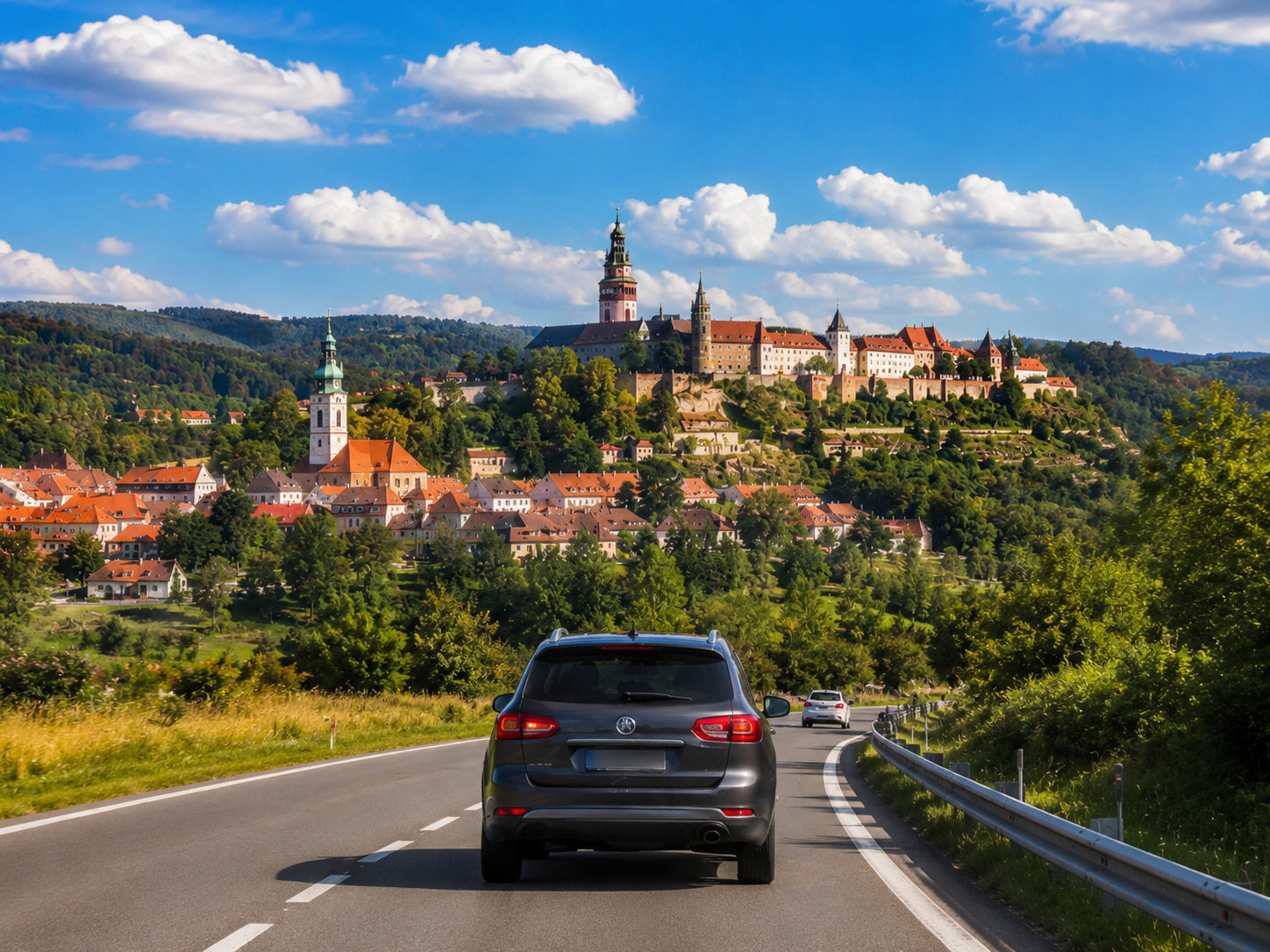
On most toll highways in the Czech Republic, passenger cars require an electronic vignette, and its price depends not only on the validity period but also on the type of powertrain. In 2026, a standard 10-day vignette costs 300 CZK, and electric vehicles can use toll roads for free provided they meet the exemption requirements. Learn how eDalnice works, what traffic rules apply in the Czech Republic, and what you should check before a road trip

The Czech Republic seems like an easy country to travel by car: short distances, a well-developed network of highways, and convenient connections between Prague, Brno, Ostrava, and neighboring countries. But the first catch appears even before you get on the highway—instead of toll booths, there’s an electronic vignette system linked to your license plate.
In this guide, we’ll cover the current traffic rules and fines in the Czech Republic, vignette prices for 2026, toll sections, rules for electric vehicles, parking, required documents, and other details you’ll actually need on the road.
Are you planning a trip to Europe by car?
In many countries, highways are tolled and require an electronic road vignette. This is a digital permit that confirms payment for the use of toll roads and is checked automatically by the license plate number - without stickers and paper receipts. Making a vignette online before you travel will help you avoid fines, travel delays, and unpleasant situations during inspections.

What traffic rules in the Czech Republic should you know before your trip?
Czech roads are generally predictable for drivers who have already traveled in Europe, but there are a few points where tourists regularly make mistakes. These include the year-round use of headlights, zero tolerance for alcohol, and fairly strict speed enforcement.
The following basic speed limits apply to passenger cars:
- 50 km/h—in built-up areas
- 90 km/h—outside built-up areas
- 110 km/h—on certain expressways
- 130 km/h—on highways
If a road sign indicates a different limit, you must follow that sign. On approaches to cities, near roadwork, and at complex interchanges, speed limits may be reduced for short stretches, so you should be especially careful when driving on the D1 highway and other heavily trafficked routes.
One of the key differences in the Czech Republic is the complete ban on drinking and driving. The legal limit is 0.0‰, so the “one glass of wine is still okay” rule does not apply here. If alcohol is detected, the driver risks a substantial fine and a driving ban.
Low beams or daytime running lights must be used year-round, both day and night. This rule applies regardless of the season or weather.
You may use a cell phone while driving only if you do not hold the device in your hand. Driving while holding a cell phone results in a fine and penalty points; the current BESIP table classifies this violation as moderately serious.
Seat belts are mandatory for the driver and passengers. Separate rules apply to children: depending on height and weight, an appropriate restraint system is required. Fines and penalty points are also imposed for not wearing a seat belt or transporting a child without the required car seat.
Another practical point concerns highways. Toll sections in the Czech Republic do not have toll gates: the presence of an electronic vignette is monitored via the vehicle’s license plate. Therefore, entering a toll section without an active e-vignette may go unnoticed by the driver, but not by the monitoring system. You can check the list of toll sections on the official eDalnice map.
To learn more about which European countries have introduced new speed limits on highways, follow the link.
Fines in the Czech Republic: How Much Do Common Violations Cost
The Czech fine system is structured such that for certain violations, drivers receive not only a monetary fine but also penalty points. Following the reform of the point system, penalties for using a cell phone, driving under the influence, speeding, and other serious violations have become significantly stricter.
Here are a few amounts you should know before your trip:
1. Using a cell phone while driving — 2,500–3,500 CZK on the spot or 4,000–10,000 CZK through administrative proceedings, plus 4 penalty points
2. Not wearing a seatbelt or transporting a child without an appropriate car seat — 1,500–2,000 CZK on the spot, or 2,000–5,000 CZK through administrative proceedings, plus 4 penalty points
3. Failure to yield the right of way—2,500–3,500 CZK on the spot or 4,000–10,000 CZK through administrative proceedings, plus 4 points
4. For the most serious violations, fines can range from 25,000 to 75,000 CZK, particularly in cases of refusing to take an alcohol or drug test or driving without a valid license
We previously discussed the most common reasons tourists are fined on European roads in 2026.
Speeding
The severity of the penalty depends on how much the driver exceeded the speed limit. Significant speeding is punished particularly severely, with penalty points added to the fine and a possible temporary suspension of the driver’s license. The Czech BESIP specifically identifies speeding violations as one of the main categories of the current point system.
Therefore, when approaching populated areas, drivers should pay close attention to the transition from 90 or 130 km/h to local limits of 70, 50, or even 30 km/h. It is precisely these short stretches with changed speed limits that often pose problems for drivers who rely on their GPS and notice the sign too late.
In our previous article, we discussed where in Europe it’s cheapest and fastest to charge an electric vehicle.
Alcohol: Even the Lowest Level Can Be a Problem
The Czech Republic has a zero-tolerance policy for drinking and driving. Driving under the influence of alcohol is punishable by a fine of 7,000 to 25,000 CZK, 6 penalty points, and a possible driving ban of up to 18 months, depending on the circumstances.
Refusing a breathalyzer test is particularly risky. This is considered one of the most serious violations: maximum administrative penalties can reach 75,000 CZK, and the consequences are not limited to a monetary fine.
We previously reported that Europe is introducing new measures to combat drunk driving: cars won’t start after alcohol consumption.
Electronic vignette in the Czech Republic: prices, validity periods, and where it’s required
In the Czech Republic, passenger vehicles weighing up to 3.5 metric tons pay for most highways via the eDalnice electronic vignette. There are no paper stickers on the windshield: during purchase, the driver enters the license plate number and country of registration, after which the right to use the toll road network is recorded in the electronic system.
In 2026, the standard rates for a passenger car are:
- 1 day — 230 CZK
- 10 days — 300 CZK
- 30 days — 480 CZK
- 1 year — 2,570 CZK
You can purchase an e-vignette through the official government website eDalnice, at designated sales points, or via special self-service terminals. When purchasing online, you must check your vehicle’s license plate number very carefully: a mistake in even a single character could mean that the system will not recognize a valid vignette for your specific vehicle.
On which roads is a vignette required?
The toll does not apply to all roads in the country, but only to specific sections of highways. The network includes, in particular, parts of the D1, D2, D3, D4, D5, D6, D7, D8, D10, D11, D35, D46, D48, D52, D55, and D56. At the same time, certain sections near major cities may be toll-free. It’s best to check the current route map on the official eDalnice website before your trip.
This is important for tourists planning only a short trip through the country. For example, simply driving onto a road marked with a “D” doesn’t always mean you have to pay on that particular section.

Who Can Pay Less or Avoid Buying a Vignette?
The Czech system also offers discounts based on the type of vehicle and its power source. For certain vehicles with low or zero emissions, reduced rates or exemptions apply; however, for vehicles with foreign license plates, you may need to notify the system in advance of your eligibility for a discount in certain cases.
Therefore, owners of electric vehicles or other cars that may be eligible for an exemption should not simply drive onto a toll road without verifying their eligibility. First, you must ensure that your vehicle meets eDalnice’s requirements and, if necessary, that its details are properly registered.
Driving on a toll road without a valid vignette can be costly: the official eDalnice portal warns of a fine of up to 20,000 CZK.
Learn more about current toll rates in Poland for 2026 by following the link.
What happens if you drive onto a toll highway without a vignette?
In the Czech Republic, there are no toll gates that physically stop a vehicle without payment. Enforcement works differently: the police and customs service check license plates via cameras, patrol cars, and checkpoints, and the system immediately detects whether a valid e-vignette is linked to a specific vehicle. Checks are also conducted at parking lots and rest areas along the highways.
If a vehicle enters a toll section without a vignette and is not eligible for an exemption, the fine can reach 20,000 CZK. Therefore, it is better to purchase an eDalnice before driving onto a toll road, rather than counting on being able to obtain one after the vehicle has already been caught on camera.
Vehicles eligible for discounts or exemptions are monitored separately. If an owner claims an exemption without legal grounds, the penalty can be up to 100,000 CZK. If a vehicle is indeed eligible for free passage but required prior notification—which was not provided—the fine can reach 5,000 CZK.
Another common cause of problems is an incorrectly entered license plate number. Before confirming the purchase, you must verify all characters, the country of registration, and the start date. After purchasing, it’s also helpful to check the vignette’s status via the official eDalnice service, especially if it was purchased a few days before your trip.
Learn more about the world’s best countries for road trips in 2026 by following the link.
Parking in the Czech Republic: Why It’s Important in Prague to Look Beyond Just the “P” Sign
In the Czech Republic, parking rules are set by individual cities, so there is no uniform system for the entire country. Prague has the most nuances, where streets are divided into blue, purple, and orange parking zones, each with its own regulations.
The blue zone is primarily intended for residents. Tourists can also park here, but only for a short time: in the city center, usually up to 1 hour, and in other areas, up to 3 hours, after paying online.
The purple zone is more convenient for visitors: it’s a mixed-use parking area for both residents and visitors. After paying, tourists can leave their cars for up to 24 hours.
Orange zones are primarily intended for short-term parking. The exact rate, hours of operation, and maximum parking time must be checked on the sign or in the official map, as conditions vary by district.
For tourists who do not plan to use a car in the city center, P+R (Park & Ride) facilities near metro stations and public transportation stops are often more convenient. Some of these facilities allow you to leave your car for 12 hours free of charge, while at others, daily parking costs 50 or 100 CZK.
There’s also an important detail for electric vehicles: starting January 1, 2026, zero-emission vehicles registered in the system will receive a 50% discount on short-term parking in Prague’s paid zones. The discount applies only to online payments—standard parking meters do not automatically apply it.
Therefore, it’s best not to look for a parking spot in Prague after you’ve already entered the city center. It’s more practical to open the official parking map in advance, check the zone color and maximum parking time, or leave your car at a P+R facility and continue your journey by public transportation.
Learn more about traffic rules, fines, toll roads, and regulations for driving in Austria in 2026 by following the link.
Winter Tires and Vehicle Equipment: What to Keep in Mind
In the Czech Republic, winter requirements depend not only on the calendar but also on actual weather conditions. From November 1 through March 31, winter tires are mandatory if there is snow, ice, or frost on the road, as well as if such conditions are expected during the trip. For passenger cars, the minimum tread depth for winter tires is 4 mm.
There is also a separate “Winter Equipment” road sign. On sections marked with this sign, winter tires may be required regardless of whether there is snow directly on the road. Such restrictions are most common in mountainous areas, so for winter trips to the Krkonoše Mountains, Šumava, or other highlands, summer tires can be a problem even in relatively good weather.
Before a long trip, it’s also a good idea to check your car’s basic safety equipment: a warning triangle, a reflective vest, and a first-aid kit. If you’ve rented a car in the Czech Republic, these items are usually included, but it’s best to double-check when you pick up the car.
For winter travel, it’s especially helpful to have an ice scraper and to completely clear the car of snow and ice in advance. The Czech Ministry of Transport reminds drivers that they must maintain sufficient visibility and not create a hazard with snow or ice that could fly off the vehicle while driving.
In our previous article, we discussed traffic rules in Italy in 2026, Autostrade tolls, fines, and key considerations for road travel.
What documents should you bring on a road trip through the Czech Republic?
No specific documents are required just for using Czech highways: the electronic vignette is linked to the license plate and has no paper equivalent. However, drivers should still carry documents confirming their right to drive and proof of insurance coverage.
The basic set includes:
- A valid driver’s license;
- Vehicle registration certificate;
- Passport or other document required for crossing the border;
- Proof of auto insurance;
- Rental agreement, if the car is rented.
Licenses issued in EU countries are recognized in other EU member states. For documents from non-EU countries, the situation depends on whether the license meets the requirements of the Geneva or Vienna Conventions on Road Traffic; in certain cases, an international driver’s license may be required.
If the vehicle is registered in an EU country, mandatory civil liability insurance is also valid in the Czech Republic and other EU member states. At the same time, the EU recommends carrying your insurance documents with you: they simplify the verification process and the handling of traffic accidents.
In a previous article, we reported that Europe is introducing mandatory surveillance cameras to monitor drivers.
Green Card for a Route Through Several Countries
For vehicles that require a Green Card during international travel, it is best to purchase insurance before departure and immediately verify that its validity period covers the entire route.
You can purchase a Green Card online at Visit World by selecting the vehicle type, destination, and desired coverage period. An important detail: a policy purchased through the Visit World service takes effect the day after it is issued, so you should not wait until the day of departure to purchase it.
Are you traveling abroad with your own car or a rented car?
Before traveling, it is important to check whether a road vignette is required for toll roads in the countries of your route. Failure to have a valid vignette can result in fines and automatic camera recordings of violations. Getting an electronic vignette from Visit World is an easy way to travel more relaxed, without unnecessary expenses and surprises on the road!
We remind you! Traveling through Europe in 2026 does not have to be expensive, even despite the general rise in prices. Analysts have compiled a rating of the most affordable destinations where you can combine relaxation, experiences, and moderate expenses. Follow the link to learn about budget locations in Europe that are worth considering for your 2026 vacation.
Products from Visit World for a comfortable trip:
Travel guide for 200 countries;
Legal advice from a local specialist on visa and migration issues;
Travel insurance around the world (please select the country of interest and citizenship to receive services);
Medical insurance all over the world.
We monitor the accuracy and relevance of our information, so if you notice any errors or inconsistencies, please contact our hotline.
Frequantly
asked questions
Is a vignette required for all highways in the Czech Republic?
Can I buy a Czech vignette on the day of my trip?
Does an electric vehicle with foreign license plates need a vignette?
What is the fine for driving without an e-vignette?
Are winter tires mandatory in the Czech Republic?
Recommended articles
2 min
Transport
Toll Roads in Poland in 2026: Current Rates and Payment Methods
Most Polish highways are toll-free for passenger cars, but tolls apply on certain sections of the A1, A2, and A4. Learn more about current rates, available payment methods, and the rules for using the e-TOLL system in 2026
07 Aug. 2026
More details3 min
Transport
Traveling to Italy by Car in 2026: Traffic Rules, Fines, Toll Roads, and ZTLs
Traveling through Italy by car makes it easy to reach small towns, the coast, and regions that are much harder to reach by public transportation. At the same time, drivers need to be aware of toll highways, restricted traffic zones (ZTL), parking rules, and hefty fines for traffic violations. Learn more about traffic rules in Italy in 2026, Autostrade tolls, fines, and the key details of traveling by car
14 Aug. 2026
More details3 min
Transport
Driving in Austria in 2026: Traffic Rules, Fines, Vignettes, and Toll Roads
To travel through Austria by car, it’s not enough to simply purchase a vignette: additional tolls apply on certain Alpine routes, and violations of the rules can result in significant fines. Drivers should also be aware of speed limits, the Rettungsgasse emergency lane, winter equipment requirements, and the specifics of the digital vignette. Learn more about traffic laws, fines, toll roads, and the rules for driving in Austria in 2026
16 Aug. 2026
More details3 min
Transport
Traveling Through Croatia by Car: Fines, Highways, Parking, and Important Traffic Rules
Croatia does not have a road vignette, but most major highways are toll roads, and the toll amount depends on the route and vehicle category. Added to this are seasonal traffic jams on roads leading to the Adriatic, speed cameras, and specific parking rules in popular tourist cities. Find out how Croatian highways work, what traffic rules and fines are in effect in 2026, and what you should consider before taking a road trip
20 Aug. 2026
More detailsAll materials and articles are owned by VisitWorld.Today and are protected by international intellectual property regulations. When using materials, approval from VisitWorld.Today is required.