

Working in Canada in 2026: Visas, Permanent Residence and the Path to Citizenship
Table of contents
- Why Does Canada Appeal to Skilled Professionals?
- Express Entry: Three Programs for Skilled Workers
- How Much Does It Cost, and How Much Money Must You Show?
- Category-Based Rounds: Who Gets Invited in 2026?
- Provincial Programs: How to Get a Nomination?
- Canada Work Visa via an Employer: 2026 Rules
- Paused Routes: Start-Up Visa, Self-Employed, Caregivers
- Moving With Family: Who Gets a Work Permit?
- Permanent Residence in Canada: Rights and Obligations
- How to Become a Canadian Citizen: Requirements and Cost

Canada remains one of the most popular destinations for those looking to move abroad for work in 2026. Learn about work visas, permanent residence, Express Entry and the path to Canadian citizenship

Canada remains one of the places where skilled professionals go with the intention of staying for good. A Canada work visa is rarely the end goal: for most people it is only the first step toward permanent residence and, eventually, a passport. The rules, meanwhile, shift quickly. Over the past few years the government has cut back temporary migration, removed points for a job offer in Express Entry, raised fees and paused several programs.
Here is what applies as of October 2026, based on data from Immigration, Refugees and Citizenship Canada (IRCC).
Applying for a visa or residence permit on your own is not something everyone manages. The document package is large, and a refusal after months of waiting can come down to a small thing: a missing paper, or a permit that does not match the purpose of the trip.
The migration lawyer service on VisitWorld knows the immigration law of many countries and helps you prepare a complete set of documents before you apply. A consultation is useful whatever your citizenship and destination country.
Choose your citizenship and destination country on VisitWorld to find a migration lawyer.

Why Does Canada Appeal to Skilled Professionals?
It has a stable economy, a labour market short of specialists in several fields, and a clear, if demanding, route to permanent status. The government's own priorities show where the demand is: healthcare, skilled trades, technical occupations, education and transport all have dedicated selection channels.
The official Immigration Levels Plan for 2026–2028 calls for 380,000 new permanent residents every year. The economic category's share will rise to 64%, and around 109,000 places in 2026 go to the federal Express Entry programs. Intake of new temporary workers and students, by contrast, is being cut to 385,000 in 2026, and the government wants temporary residents to fall below 5% of the population by the end of 2027. So counting on a temporary permit to somehow turn into permanent status is increasingly risky. It is better to plan a route to PR from the start.
Visit World services for tourists, migrants, and expats: Insurance | Guides | Legal advice
Express Entry: Three Programs for Skilled Workers
Express Entry is not a visa in itself. It is a system that manages applications under three federal programs. First, a candidate creates a profile and the system assigns a Comprehensive Ranking System (CRS) score. IRCC then periodically invites those with the highest scores, or those who fit a particular category. After an invitation to apply for PR, you have 60 days to gather and submit your documents.
Read also: Canada is raising the work experience requirement for Express Entry from 2026.
The Federal Skilled Worker Program is designed for people working outside Canada. It requires at least one year of continuous work in your main occupation within the last ten years, and the occupation must fall under TEER levels 0–3 of Canada's NOC classification. You also need secondary education, language ability at CLB 7 (English or French) and 67 points out of 100 on a separate scoring grid that takes into account education, age, language, experience, adaptability and a job offer. A foreign degree usually needs an Educational Credential Assessment (ECA).
The Federal Skilled Trades Program is built for skilled trades: electricians, plumbers, welders, cooks, bakers, truck drivers. It requires two years of experience in the last five, plus either a full-time job offer of at least one year or a certificate of qualification issued by a Canadian authority. Education is not required, and the language bar is lower: CLB 5 for speaking and listening and CLB 4 for reading and writing.
The Canadian Experience Class suits people who have already worked in Canada. You need one year of skilled work experience in the last three years. TEER 0 and 1 occupations require CLB 7, while CLB 5 is enough for TEER 2 and 3, and no education is required. Work done without authorization, self-employment and work while studying do not count.
A job offer is not required to enter the pool. Since March 25, 2025, it no longer adds any CRS points at all. It keeps some weight only in the FSWP scoring grid.
There is also news worth keeping in mind. In April 2026, IRCC opened consultations on merging all three programs into a single federal high-skilled program. No final decisions have been made, and the current three remain in force, so check the latest rules on the IRCC website before applying.
Temporary work permit in Quebec in 2026: a new opportunity for skilled workers.
How Much Does It Cost, and How Much Money Must You Show?
The principal applicant pays CAD 1,590 for a permanent residence application through Express Entry. That covers the processing fee (CAD 990) and the right of permanent residence fee (CAD 600). A partner included in the application pays the same, and each child costs CAD 270. For a family of two adults and two children, that comes to CAD 3,720 in government fees, plus biometrics (CAD 85 per person, capped at CAD 170 per family). The right of permanent residence fee is refunded if the application is withdrawn or refused. The processing fee is not.
FSWP and FSTP candidates must also prove they will have enough money to live on at the start. The minimum amounts depend on family size:
- 1 person: CAD 15,263;
- 2 people: CAD 19,001;
- 3 people: CAD 23,360;
- 4 people: CAD 28,362 (each person beyond seven adds CAD 4,112).
Family size includes everyone, even a partner and children who are not coming with you. Proof comes in the form of bank letters on the institution's letterhead showing balances and the average balance over six months. Borrowed money and equity in real estate are not accepted. CEC candidates are exempt from this requirement, as are those who already hold a work permit in Canada and have a valid job offer.
Canada's new Start-Up Visa pilot is here.
Category-Based Rounds: Who Gets Invited in 2026?
Beyond the general rounds, IRCC runs targeted ones. In 2026 there are ten categories: French language, healthcare and social services, STEM, skilled trades, education and transport. Three more (physicians, senior managers and researchers) require Canadian experience, and the tenth is reserved for skilled military recruits. The agriculture category has not been brought back this year. Most categories require 12 months of experience in the last three years, and it can be gained abroad. The exceptions are physicians, senior managers and researchers, for whom only Canadian experience counts. The French-language category is not tied to an occupation: a high enough language level is all it takes.
Provincial Programs: How to Get a Nomination?
Each province (except Quebec) has its own streams and decides for itself which specialists it needs. If a province nominates a candidate through an Express Entry-linked stream, the candidate receives 600 extra CRS points, and an invitation to apply for PR is practically guaranteed. There are also base streams: there the nomination is processed separately, and the PR documents go to IRCC as a paper application, without CRS points. Requirements, timelines and fees differ by province, so rely on the website of the specific province. Quebec selects its economic immigrants through its own system, using the CSQ certificate, and that system runs by different rules.
Canada Work Visa via an Employer: 2026 Rules
If the route to PR is closed for now, many people start with a temporary permit. The Temporary Foreign Worker Program (TFWP) requires the employer to obtain an LMIA, a Labour Market Impact Assessment. The permit is tied to one specific employer. Changing jobs means a new LMIA and a new permit. Another route, the International Mobility Program, works without an LMIA: it covers, for example, intra-company transfers and youth exchanges under International Experience Canada.
In 2026, conditions for low-wage positions are tougher. Applications for such roles are not processed in cities and metropolitan areas where unemployment is 6% or higher. The share of foreign workers on staff is capped at 10%, and the maximum permit length has been cut to one year. Since April 2026, employers must also advertise a vacancy for eight weeks. Exceptions apply to healthcare, construction and food processing. The wage threshold for the high-wage stream has been raised. The work permit itself costs CAD 155 and biometrics CAD 85, while the LMIA fee is paid by the employer.
The best cities in Canada for expats are covered in the article at the link.
Paused Routes: Start-Up Visa, Self-Employed, Caregivers
Some once-popular routes are currently unavailable. The Start-Up Visa stopped accepting new applications after December 31, 2025, and the Centralized Intake Office stopped registering them as of June 30, 2026. The Self-Employed Persons Program (culture and athletics) has been on pause since April 2024, and IRCC currently has no date for reopening it. The government has said it intends to launch a new targeted program for entrepreneurs, but the details that could be confirmed are still limited.
The Home Care Worker Immigration Pilots, for the care of children and of people who need assistance, launched on March 31, 2025. They replaced the earlier caregiver programs, but the IRCC page marks both streams as closed. Annual caps have most likely been used up, so check the status before spending any money.
Moving With Family: Who Gets a Work Permit?
If you get PR through Express Entry, your partner and children are included in the same application, and fees are calculated as outlined above. With a temporary permit, things are more complicated. Since January 21, 2025, a partner can get an open work permit only if you work in a TEER 0 or 1 position, or in a select TEER 2–3 position, and your permit is valid for at least 16 more months. Children of highly skilled workers no longer qualify for such a permit. An exception applies to families of workers who have already applied for PR under one of the economic programs: conditions are softer for them, and six more months of permit validity is enough. Outside these cases, a family member can obtain a separate work permit, or student or visitor status.
Family sponsorship is also an option. A Canadian citizen or permanent resident can sponsor a spouse or partner, children, parents and grandparents. The sponsorship fee for a spouse or parents is CAD 1,260, and CAD 180 for a child.
Permanent Residence in Canada: Rights and Obligations
A permanent resident can live, work and study in any province, is protected by Canadian law and does not have to renew a visa. Provincial authorities enroll the new resident in public health insurance, so conditions and waiting periods vary by region. Permanent residents cannot vote in elections. To keep the status, you must spend at least 730 days in Canada in every five-year period. A permanent resident card costs CAD 50.
How to Become a Canadian Citizen: Requirements and Cost
The requirements for Canadian citizenship are considerably simpler than the route to PR itself, but they set clear arithmetic limits. The applicant must be a permanent resident with no unfulfilled conditions on their status and meet the following:
The applicant must have been physically present in Canada for at least 1,095 days in the five years before applying, including at least 730 days as a PR. Days spent in Canada before becoming a PR under temporary status count at half weight, up to a maximum of 365 days. Taxes must be filed for three of the last five years, if the law requires it. Between the ages of 18 and 54, you must prove English or French at CLB 4 and pass the knowledge test. The oath follows. Convictions and security concerns can be an obstacle.
The application fee is CAD 653 for an adult (CAD 530 for processing plus CAD 123 for the right of citizenship) and CAD 100 for a minor. IRCC advises applying with a margin of extra days so that a miscount does not trip you up.
Canada's system is built so that a single inaccuracy in a profile costs months of waiting. A candidate has to choose between Express Entry, a provincial nomination and an employer-backed permit, work out the right NOC code and confirm experience with employer letters. Credential assessment, bank letters showing a six-month average balance and the family composition, which determines the entire proof-of-funds amount, call for extra attention. If you are moving with a partner, a lawyer can help you work out whether they will qualify for an open work permit, since the criteria were narrowed in 2025. Canadian rules change several times a year, so it pays to check your plan with a specialist before you apply.
The migration lawyer on VisitWorld will analyze your situation, suggest a realistic route and prepare your documents so they are not returned as incomplete. Enter your citizenship and destination country on VisitWorld and book a consultation with a migration lawyer.
A reminder! Canada is one of the most immigrant-friendly countries in the world, but the real path to work here takes a clear plan. We have already covered which work permits exist in 2026, how Express Entry and the Working Holiday Visa work, which professions are in demand, what Canadian employers pay, how to write a résumé and where to look for jobs, all in one detailed guide.
Photo: generated by Gemini
Products from Visit World for a comfortable trip:
Travel guide for 200 countries;
Legal advice from a local specialist on visa and migration issues;
Travel insurance around the world (please select the country of interest and citizenship to receive services);
Medical insurance all over the world.
We monitor the accuracy and relevance of our information, so if you notice any errors or inconsistencies, please contact our hotline
Frequantly
asked questions
What are NOC and TEER, and why does a candidate need them?
How long does it take to process a PR application through Express Entry?
Does Canada allow dual citizenship?
Recommended articles
3 min
Travels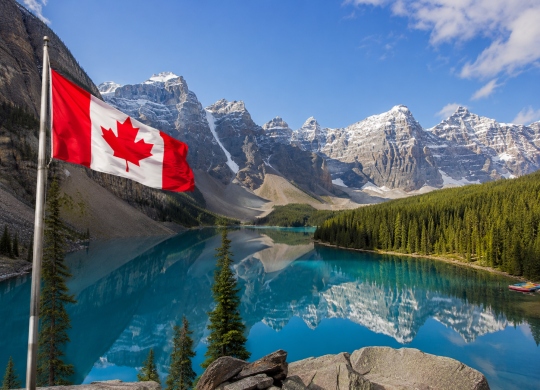
What You Need to Know Before Traveling to Canada in 2026: Visas, Documents, and Entry Requirements
Planning to visit Canada? Before your trip, it’s a good idea to familiarize yourself with the entry requirements, prepare the necessary documents, check the visa rules, and learn about customs restrictions. Find out what documents tourists need, what questions you might be asked at the border, how much cash you’re allowed to bring in, whether health insurance is required, and what other details will help you avoid unpleasant surprises during your trip
02 Jul. 2026
More details3 min
Expats
Canada 2026: Updated Permanent Residency Rules, New Passport Fees, and Changes to Work Permits
Spring 2026 brought nine significant updates to the Canadian immigration system—ranging from revised fees for citizenship and passports to new provincial powers in selecting candidates for permanent residency. The updates also affected settlement programs, family sponsorship, and employment conditions in rural communities. Learn more about each of the changes, the new fee amounts, and the practical implications for applicants
14 Apr. 2026
More details2 min
Expats
Fastest Countries to Get Citizenship in 2026: Top 10 Easiest Paths to a Second Passport
Some countries allow citizenship after 2–5 years of legal residence. Find out which countries offer the fastest path to a second passport in 2026, what the naturalization requirements are, and what to consider before moving
09 May. 2026
More details2 min
Expats
Best Cities in the World for Expats in 2026: Top Places to Relocate and Live Comfortably
Moving abroad is becoming increasingly popular among people seeking a better quality of life and new opportunities. Find out which cities topped the list of the most comfortable for expats in 2026 and why they became the leaders
07 Jun. 2026
More detailsAll materials and articles are owned by VisitWorld.Today and are protected by international intellectual property regulations. When using materials, approval from VisitWorld.Today is required.